

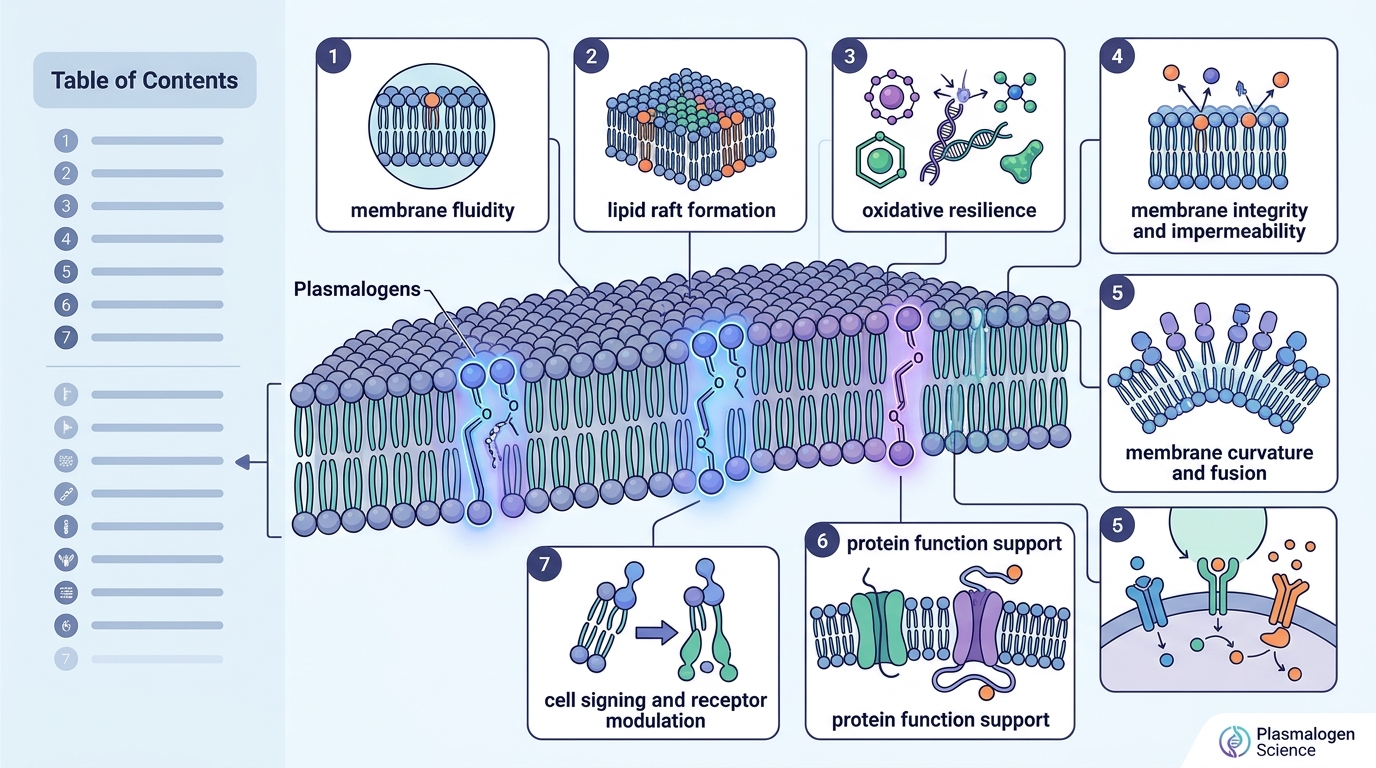
Plasmalogens are specialized ether phospholipids that provide unique structural and protective functions within cell membranes. Unlike standard phospholipids, they contain a vinyl ether bond that influences membrane fluidity, curvature, and oxidative resilience. This article explores the specific mechanisms by which these lipids maintain cellular integrity and support biological function.
1. Modulating Membrane Fluidity and Flexibility
Plasmalogens maintain optimal membrane fluidity by preventing excessive lipid packing. The unique molecular shape of plasmalogens, driven by their vinyl ether bond, creates a distinct cross-sectional area compared to standard ester-linked phospholipids. This structural difference allows membranes to remain flexible and responsive to environmental changes. In tissues with high metabolic demands, such as the brain and heart, this flexibility is critical for maintaining cellular homeostasis.
2. Influencing Membrane Curvature and Vesicle Dynamics
Plasmalogens promote positive membrane curvature, which is essential for vesicle formation and fusion. The conical shape of plasmalogen molecules encourages the bending of lipid bilayers. This property is vital for processes like endocytosis, exocytosis, and synaptic vesicle release. By facilitating these dynamic shape changes, plasmalogens ensure that cells can efficiently transport materials and communicate with their surroundings.
3. Acting as Sacrificial Antioxidants
The vinyl ether bond in plasmalogens acts as a sacrificial antioxidant, protecting the membrane from oxidative damage. When exposed to reactive oxygen species, plasmalogens are preferentially oxidized, thereby shielding other critical membrane lipids from peroxidation. This protective mechanism helps preserve the structural integrity of the cell membrane under oxidative stress. It is a key reason why plasmalogens are abundant in tissues exposed to high metabolic activity.
4. Organizing Lipid Rafts and Signaling Domains
Plasmalogens contribute to the formation and stability of lipid rafts, which are specialized microdomains for signaling. These rafts concentrate specific proteins and lipids, creating organized platforms for cellular communication. By influencing the local lipid environment, plasmalogens help regulate the activity of signaling proteins and receptors. This organization is crucial for efficient signal transduction and immune response coordination.
5. Supporting Myelin Sheath Integrity
Plasmalogens are highly concentrated in myelin, where they support the structural stability of nerve insulation. Myelin is a lipid-rich sheath that wraps around axons to facilitate rapid signal conduction. The presence of plasmalogens in myelin helps maintain its layered structure and functional integrity. This is particularly important in the central and peripheral nervous systems, where myelin health directly impacts cognitive and motor function.
6. Facilitating Membrane Repair and Remodeling
Plasmalogens play a role in the dynamic remodeling and repair of cell membranes. Cells constantly undergo membrane turnover, requiring the addition and removal of lipids to maintain balance. Plasmalogens are involved in these remodeling processes, helping to restore membrane integrity after injury or stress. Their ability to integrate into and reorganize within the bilayer supports the cell's capacity for self-repair.
7. Regulating Protein Positioning and Function
Plasmalogens influence the local environment where membrane proteins reside, affecting their activity. The physical properties of the membrane, including fluidity and curvature, are determined in part by the lipid composition. By shaping these properties, plasmalogens help position and orient membrane proteins correctly. This ensures that transporters, channels, and receptors function optimally within the cellular context.
Choosing the Right Context for Membrane Analysis
When evaluating membrane health, it is important to consider the specific tissue and biological context. Plasmalogens are not isolated markers but part of a complex lipid network. Understanding their role requires looking at the broader lipidomic profile, including other phospholipids, fatty acids, and oxidative stress markers. This holistic approach provides a more accurate picture of cellular resilience and function.
Frequently Asked Questions
What is the primary structural difference between plasmalogens and standard phospholipids?
Plasmalogens contain a vinyl ether bond at the sn-1 position of the glycerol backbone, whereas standard phospholipids typically have an ester bond. This difference gives plasmalogens unique physical and chemical properties.
Why are plasmalogens important for brain health?
Plasmalogens are highly concentrated in brain tissue, particularly in myelin and synaptic membranes. They support signal conduction, synaptic plasticity, and protection against oxidative stress, all of which are critical for cognitive function.
How do plasmalogens protect against oxidative stress?
The vinyl ether bond in plasmalogens is susceptible to oxidation. By being oxidized first, plasmalogens act as sacrificial antioxidants, protecting other membrane lipids from damage and maintaining membrane integrity.
Can plasmalogen levels be measured in blood?
Yes, plasmalogen levels can be measured in blood samples, including red blood cells, plasma, and serum. These measurements can provide insights into ether lipid metabolism and membrane health.
Do plasmalogens play a role in aging?
Yes, plasmalogen levels often decline with age. This decline is associated with changes in membrane fluidity, increased oxidative stress, and altered cellular function, making plasmalogens a potential biomarker for biological aging.