

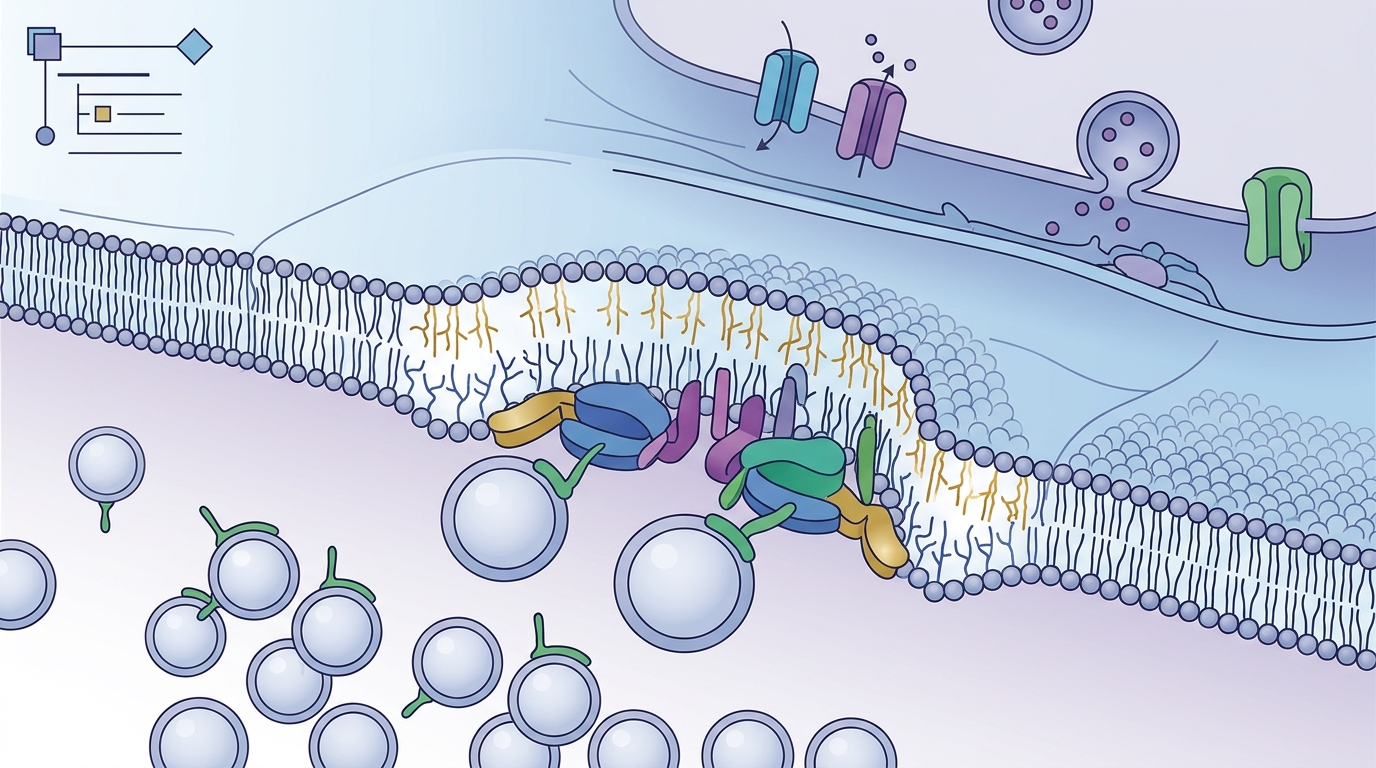
Plasmalogens organize SNARE proteins by creating specific lipid microenvironments that facilitate the clustering and docking of synaptic vesicles. This structural arrangement allows for faster and more efficient neurotransmitter release. By influencing membrane curvature and lipid packing, these ether phospholipids ensure that the molecular machinery required for synaptic transmission is properly aligned and ready for rapid action.
The Structural Foundation of Synaptic Vesicles
Synaptic vesicles are small, membrane-bound sacs that store neurotransmitters. Their ability to fuse with the presynaptic membrane depends heavily on the physical properties of their lipid bilayer. Plasmalogens are specialized ether phospholipids that are highly concentrated in these vesicles. Their unique molecular shape, driven by the vinyl ether bond, creates a distinct curvature stress within the membrane. This curvature is essential for the initial stages of vesicle docking.
The presence of plasmalogens helps maintain the flexibility required for vesicle deformation. Without this specific lipid composition, the membrane may become too rigid or too disorganized. This structural integrity is a prerequisite for the subsequent steps of synaptic transmission. The organization of the membrane directly dictates how effectively the vesicle can interact with the target membrane.
SNARE Complex Assembly and Lipid Rafts
SNARE proteins are the molecular tethers that physically pull the vesicle and target membranes together. For these proteins to function, they must assemble into a tight, four-helix bundle. Plasmalogens contribute to the formation of lipid rafts, which are specialized microdomains enriched in specific lipids and proteins. These rafts act as platforms where SNARE proteins can concentrate and interact. By organizing these proteins into functional clusters, plasmalogens reduce the time required for complex assembly.
The lipid environment created by plasmalogens influences the lateral mobility of SNARE proteins. This mobility is critical for the proteins to find their partners and form the necessary complexes. When the lipid packing is optimal, the SNARE proteins are positioned correctly for rapid fusion. This organization is a key factor in the speed of synaptic transmission, allowing for the high-frequency signaling required in the brain.
Impact on Fusion Kinetics and Speed
The speed of synaptic transmission is determined by the kinetics of vesicle fusion. Plasmalogens influence this process by modulating the energy barrier for membrane merger. The specific lipid composition of the vesicle membrane affects how easily the two membranes can merge. Plasmalogens help lower this barrier by providing the necessary curvature and fluidity. This results in faster fusion events, which is crucial for the rapid communication between neurons.
Connection to Neurological Health and Aging
The role of plasmalogens in SNARE organization has significant implications for neurological health. As the brain ages, plasmalogen levels naturally decline. This decline can affect the structural integrity of synaptic vesicles and the efficiency of SNARE complex assembly. The resulting changes in membrane properties may contribute to the cognitive decline observed in aging. Maintaining healthy plasmalogen levels is therefore important for preserving synaptic function over time.
Furthermore, plasmalogens play a role in protecting membranes from oxidative stress. Oxidative damage can disrupt lipid packing and impair SNARE protein function. By acting as sacrificial antioxidants, plasmalogens help preserve the membrane environment necessary for efficient synaptic transmission. This protective role is particularly important in the brain, which is highly susceptible to oxidative stress due to its high metabolic activity.
Key Takeaways
- Plasmalogens are ether phospholipids that create specific membrane curvature essential for vesicle docking.
- They facilitate the clustering of SNARE proteins within lipid rafts, speeding up complex assembly.
- The lipid environment provided by plasmalogens lowers the energy barrier for membrane fusion.
- Optimal plasmalogen levels support the rapid kinetics required for efficient synaptic transmission.
- Declining plasmalogen levels with age may contribute to impaired synaptic function and cognitive decline.
- Plasmalogens protect the synaptic membrane from oxidative stress, preserving SNARE protein integrity.
Frequently Asked Questions
What are SNARE proteins?
SNARE proteins are a family of proteins that mediate the fusion of vesicles with target membranes. They form a tight complex that pulls the two membranes together, allowing for the release of neurotransmitters.
How do plasmalogens differ from other phospholipids?
Plasmalogens contain a vinyl ether bond at the sn-1 position of the glycerol backbone, whereas most other phospholipids have an ester bond. This structural difference gives plasmalogens unique properties, including the ability to create membrane curvature.
Why is membrane curvature important for synaptic transmission?
Membrane curvature is essential for the initial docking of synaptic vesicles with the presynaptic membrane. It helps position the SNARE proteins correctly and facilitates the subsequent fusion of the membranes.
Can plasmalogen levels be measured in blood?
Yes, plasmalogen levels can be measured in blood samples, such as red blood cells or plasma. These measurements can provide insights into overall membrane lipid status and potential neurological health.
How does aging affect plasmalogen levels?
Plasmalogen levels generally decline with age. This decline is associated with changes in membrane properties and may contribute to age-related cognitive decline and impaired synaptic function.
Conclusion
Plasmalogens play a critical role in organizing SNARE proteins for faster synaptic transmission. By creating the appropriate lipid environment, they ensure that the molecular machinery required for neurotransmitter release is efficient and rapid. Understanding this relationship is essential for comprehending how membrane biology influences brain function. For more in-depth information on the science of plasmalogens and their role in cellular health, visit Plasmalogen Science.